
1

Gambiva
Valid Today Welcome package across several deposits
- Casino and sportsbook under one roof
- Large game library and a loyalty programme
5.0Our rating
Exchange betting · 7 sites ranked
On a betting exchange the prices come from other customers, not from a bookmaker. This page covers back and lay bets, how a lay liability is worked out, where the commission sits, and how the seven ranked sites differ from an exchange.
The seven sites below are bookmakers and casinos. You bet against the operator at the price it sets, which is a different product from an exchange, where you bet against another customer. We list them because they are the sites on our scoreboard that sit closest to a betting account, and because the questions an exchange raises are the ones to ask of any site: price, fee, limits, terms.
Gambiva and Beonbet put a casino and a sportsbook on one account. The other five are casino-first. If you want a true exchange, look on the operator's own page for an exchange product and read its commission and rules there; nothing in this list tells you that one exists. Sites are ranked by our rating, best first.
Valid Today Welcome package across several deposits

Valid Today Welcome package across your first deposits

Valid Today Four-deposit welcome package

Valid Today Separate welcome packages for casino and for sport

Valid Today Welcome offer with a short window to wager

Valid Today Multi-step welcome package

Valid Today Tiered welcome package
| Site | Our rating | Product | Offer | Read first | Link |
|---|---|---|---|---|---|
| Gambiva | 5.0 | Casino and sportsbook | Valid Today Welcome package across several deposits | Which bets the package covers | Visit site |
| Kaasino | 4.8 | Casino-first | Valid Today Welcome package across first deposits | Payment methods and bonus eligibility | Visit site |
| Seven casino | 4.7 | Casino-first | Valid Today Four-deposit welcome package | 10x wagering and £5 maximum bet, per reviews | Visit site |
| Beonbet | 4.6 | Casino and sportsbook | Valid Today Separate casino and sport packages | The sport package terms | Visit site |
| Spinfin | 4.5 | Casino-first | Valid Today Welcome offer, short window to wager | The bonus stake limit | Visit site |
| Fox Slots | 4.4 | Casino-first | Valid Today Multi-step welcome package | The terms of each step | Visit site |
| Runa casino | 4.2 | Casino-first | Valid Today Tiered welcome package | Free spin and cashback rules | Visit site |
A bookmaker earns its margin inside the price. An exchange earns commission on net winnings. The table stays on the bookmaker side because that is the product each of these sites sells, and the offer column is the one thing that differs between them before you place a bet.
Our rating covers the whole site. For a page about exchange-style betting, we weight the points below.
Bonus clarity weighs most. On a page about exchanges it also tells you whether you can combine promotions with back and lay bets at all, and the answer is often no. Licence checks come second. Payment and mobile quality break ties.
Gambiva leads the list because it puts a sportsbook next to a casino, with a welcome package across several deposits, a loyalty programme and a large game library. For someone who wants to compare a bookmaker's price with what an exchange would show, a real sportsbook is the starting point.
It is a bookmaker, so the price you take is the price it offers, with its margin built in. Some reviews put slot wagering at 20x, a casino figure. If an exchange matters to you, look on the operator's page for a separate exchange product and read its commission rules before you rely on one.
Cost is the thread on an exchange page, and Kaasino is reported to charge no fees on deposits or withdrawals. Reviews list debit cards, PayPal, Skrill, Neteller and Trustly. If you move money in and out often, as a back and lay bettor does, that is worth more than a big headline bonus.
The welcome package covers your first deposits. A bonus is usually tied to the bookmaker's own markets and wagering rules, so check before you assume it can stand behind a hedge. It is casino-first, so confirm the sportsbook details on the operator's page.
The welcome package at Seven casino runs across four deposits, with 10x wagering on welcome bonuses and 100% slot contribution, according to reviews. For a reader who thinks in margins and fees, those are numbers with a definite meaning: a £100 bonus at 10x means £1,000 of bets before the funds are yours.
A maximum bet of £5 with a bonus applies, reviews report. That caps any attempt to bet large while the bonus is live. Seven casino is a bookmaker and casino, so there is no lay side here, and its rules are the first stop if you are weighing the offer.
Casino and sportsbook share one Beonbet account, with a separate welcome package for each. When you compare a bookmaker's odds with exchange prices, you want the sportsbook side, so the sport package and its rules are the ones to read.
Reviews put the casino bonus at 40x wagering. That is a different product from the sport offer, and the two sets of terms should not be mixed. Check the operator's page for what it says about its sportsbook, and for any exchange-style product, before you commit funds.
Spinfin has around 6,000 games by review reports, and a welcome offer with a short window to wager. Short windows reward activity and punish a slow, selective approach, which is how many people use an exchange.
A stake limit applies while the bonus is active. In practice that means the offer suits small, frequent bets and not a single large lay-style position. As a casino-first site, it is worth opening the operator's page to see what sports markets and what price rules it publishes.
Fox Slots is built around slots, and its welcome package comes in several steps. It belongs on this page as a reference point: a casino-first site with no pretence of being an exchange, whose bonus conditions you read step by step.
If your interest is in back and lay betting, treat Fox Slots as a place to compare how a fixed-price site handles its offer. Each step of the package has terms of its own, and the operator's page is where they sit.
Runa casino offers a tiered welcome package, cashback and free spins. Cashback is the closest thing a casino has to an exchange idea: a share of net losses comes back, which is a cost-reduction device.
Free spins have their own terms, and cashback has conditions on how and when it is paid. Read both on the operator's page. This is a casino-first site, so expect a games catalogue and not a back and lay market.
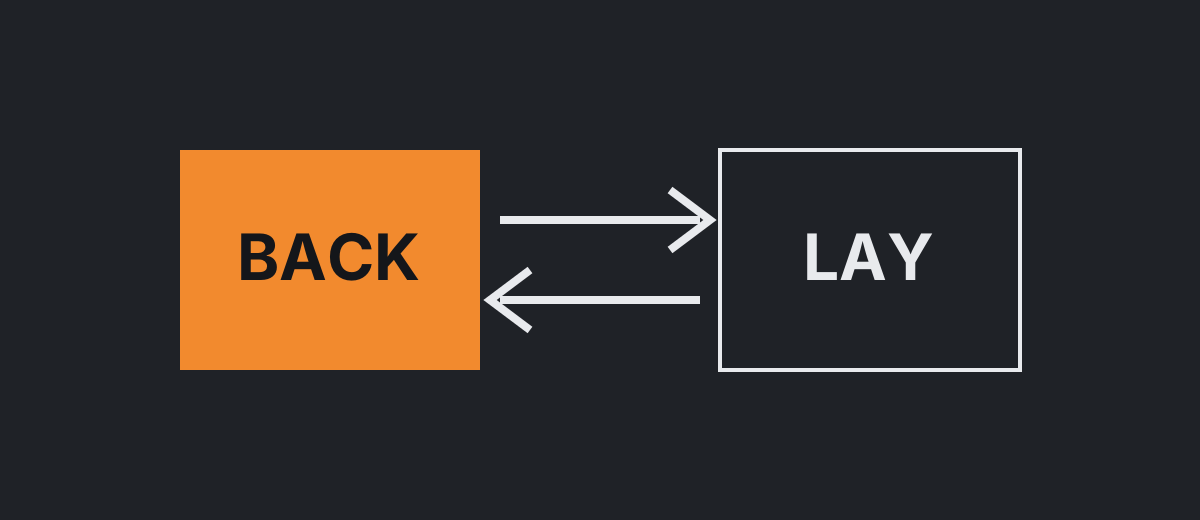
A normal bookmaker sets a price and takes your bet. On an exchange you choose a side. Backing is a bet that a selection wins. Laying is a bet that it does not. Each lay needs a backer, and each back needs a layer, so the two sides meet at a price they agree on.
The price is set by the people using it. If more customers want to back a team, the price shortens. If more want to lay it, the price drifts. That is why exchange prices move all day, and why an offer to match your stake at 3.00 (2/1) can vanish before you confirm.
Two prices show on screen for each selection. The back price is the best one on offer to anyone who wants to back it, and the lay price is the best one for anyone who wants to lay it. The gap between them is the spread, and in a busy market it is small.
Fractional odds are the common style in UK shops, and exchanges mostly show decimals. Our guide to fractional odds shows how to convert between them, so that 2/1 and 3.00 read as the same price.
Laying carries a liability. The formula is the lay stake multiplied by the decimal odds minus one. Work that figure out before you click, not after.
Lay £10 at 3.00 (2/1). Liability: £10 × (3.00 − 1) = £20. If the selection loses, you win the backer's £10. If it wins, you pay out £20.
| Lay stake | Odds | Liability | If it loses | If it wins |
|---|---|---|---|---|
| £10 | 3.00 (2/1) | £20 | You win £10 | You pay £20 |
| £25 | 5.00 (4/1) | £100 | You win £25 | You pay £100 |
| £50 | 1.50 (1/2) | £25 | You win £50 | You pay £25 |
The second row is the one that catches beginners. A £25 stake sounds small, but at 5.00 (4/1) the amount at risk is four times the stake. The liability is held in your account while the bet is open, so a layer needs the full £100 available, not £25.
Commission is the exchange's fee. It is charged on net winnings in a market, and not on losses.
You back £10 at 3.00 (2/1). If it wins, you make £20 profit before commission. Illustration: at 5% commission, £1 comes off, so you keep £19. The operator sets its own rate in its terms.
| Result | Before commission | Commission at 5% | After commission |
|---|---|---|---|
| The bet wins | £20 profit | £1 | £19 profit |
| The bet loses | £10 stake lost | £0 | £10 lost |
Commission is set by each operator, and some exchanges adjust it for accounts that win consistently or reward high volume. Read the fee page before you bet, as it affects every result.
A bookmaker builds a margin into every price, so the implied chances add up to more than 100%. An exchange has no margin in the price, only commission on winnings. The two costs look different and need converting to compare.
Take a two-way market. A bookmaker prices both sides at 1.90 (10/11). The implied probabilities, 1 divided by 1.90, are about 52.6% each, adding to roughly 105.3%. On an exchange the same sides might trade at 2.00 (1/1). At 5% commission, a back bet at 2.00 returns an effective 1 + (2.00 − 1) × 0.95 = 1.95. That is a better price than 1.90, though only in this made-up case.
The comparison does not always favour the exchange. Thin markets, wide spreads and higher commission can reverse it, and bookmaker boosts or offers sometimes beat both. Compare the effective price, not the headline number.
Liquidity is the amount of money waiting to be matched at a price. A top football match or a major race has plenty, so a £50 bet is matched at once. A minor market may have a few pounds at the best price and a wide gap behind it.
Part of a bet can sit unmatched while the market moves. Some exchanges hold in-play bets for a few seconds before they are accepted, so the price you saw may not be the price you get. Check the operator's rules on delays and unmatched bets.
Matched betting is a technique that backs a selection at a bookmaker and lays it on an exchange, so the result matters less than the price difference between the two. The lay stake that evens out both outcomes is the back stake multiplied by the back odds, divided by the lay odds.
Say you back £10 at 3.00 (2/1) and lay at 3.10. The lay stake is £10 × 3.00 ÷ 3.10 = £9.68, with liability of £20.32. If the bet wins you gain £20 and pay £20.32, a net loss of £0.32. If it loses, you lose £10 and win £9.68, the same £0.32. Hedging locks in a small, known cost, and does not remove it.
Some people use the method with bookmaker free bets, where the stake is not at risk, and the arithmetic changes. Operators set their own rules on bonuses and on accounts they consider abusive, and can restrict or close them. This page does not recommend building a plan around promotions.
On an exchange you bet against another customer, and the operator is a middleman. On the seven sites above you bet against the operator, which takes the other side at a price it sets. That is a bookmaker, and a casino-first site is a bookmaker in a different outfit.
If you want an exchange, look on the operator's page for a product called exchange, trading or back and lay. Check its licence in the UKGC public register, its commission, its limits, and how withdrawals and in-play delay are handled. Then compare the price with a bookmaker's for the same market.
Prices on an exchange move fast, so test the confirmation screen on your phone with a small stake. Debit cards, PayPal, Skrill and Trustly are widely accepted by UK sites, though each operator lists what it supports. Commission and deposit rules decide how much a small win leaves you with.
Welcome offers at bookmakers usually count only bets at the operator's own prices, and may exclude hedged or exchange-style bets. Wagering, expiry and maximum stakes are all explained with sums on our bonus terms explained page.
A 10x wagering limit from 19 January 2026 has been reported, so check what applies to your offer on gamblingcommission.gov.uk before you rely on a review.
Our responsible gaming page lists the tools in more detail. Laying is not a safer way to bet: a single lay at a long price can cost many times the stake.
A lay bet is a bet that something will not happen. You act as the bookmaker for another customer. If you lay £10 at 3.00 (2/1), you win their £10 when the selection loses and you pay out £20 when it wins.
Yes. A bookmaker sets the price and takes your bet itself. An exchange matches you with another customer who takes the other side, and the operator charges commission, set in its terms.
Multiply the lay stake by the decimal odds minus one. A £25 lay at 5.00 (4/1) gives £25 × 4, which is £100. That amount is reserved in your account while the bet is open.
They are bookmakers and casinos, and we do not list an exchange for any of them. If you want one, check the operator's own page for an exchange product and read its commission and rules there.
It is set by each operator and charged on net winnings in a market. A 5% rate on a £20 profit would take £1, which is an illustration only. The fee page of the exchange shows the actual rate.
It is the money waiting to be matched at a given price. Popular events have plenty and match quickly. Quiet markets may have little, so bets can go unmatched or fill at a worse price.
No. Hedging a back bet with a lay bet locks in a known result, which can be a small loss, as in the £0.32 example above. Operators also set their own rules on promotions and can restrict accounts.